Transportation — Towing

Towing Insurance for Vehicles in Your Care

Rollback, wheel-lift, heavy recovery, roadside, storage, and repossession work carry different auto, on-hook, garagekeepers, and workforce considerations. BLIS separates the fleet, custody, driver, radius, contract, and loss details before submission.

Licensed commercial insurance support across 5 states

Smart intake

Towing quote

One question to start. We do the reading from there.

Start your quote

Get Started

Request a Towing insurance quote

Complete the required contact fields and a few business details. A licensed BLIS representative will review the request.

1 / 2About you

How to reach you about your request.

We use this only to follow up.

Licensed in CA, NV, AZ, TX, and FL.

We only use this information to review your insurance request. BLIS is licensed in California, Nevada, Arizona, Texas, Florida. CA License 0M74955.

Submitting this form does not bind coverage and does not promise a specific quote, price, or coverage outcome. BLIS reviews submitted details and may follow up for information needed to evaluate the account.

What to expect

What to expect after you submit

A BLIS representative reviews the information you submit and follows up if something important is missing.

  1. A real person reads it

    Your details get read against what carriers actually want for your kind of account — not routed through a form stack.

  2. Your account gets matched

    How you operate maps to the coverage lines and markets that fit the risk.

  3. Gaps get filled

    If something important is missing, a few targeted questions — not another long form.

  4. Options get laid out

    Coverage, exclusions, carrier fit, and cost — side by side, not just price.

  5. Bound? We stay on.

    Certificates, endorsements, audits, renewals, policy changes — handled.

Prefer to talk it through? Call (818) 306-8333Monday – Friday, 9:00 AM – 5:00 PM PT

Your operation

How towing operations shape the insurance review

Tow trucks work in conditions that make carriers pay attention. Accident scenes. Night calls. Damaged property in your custody. Storage lots full of vehicles that belong to other people. Each piece of your operation carries its own exposure — on-hook, garagekeepers, roadside struck-by, MVR-sensitive drivers. Carriers that write towing regularly know what to look for. So does a submission that's organized for them.

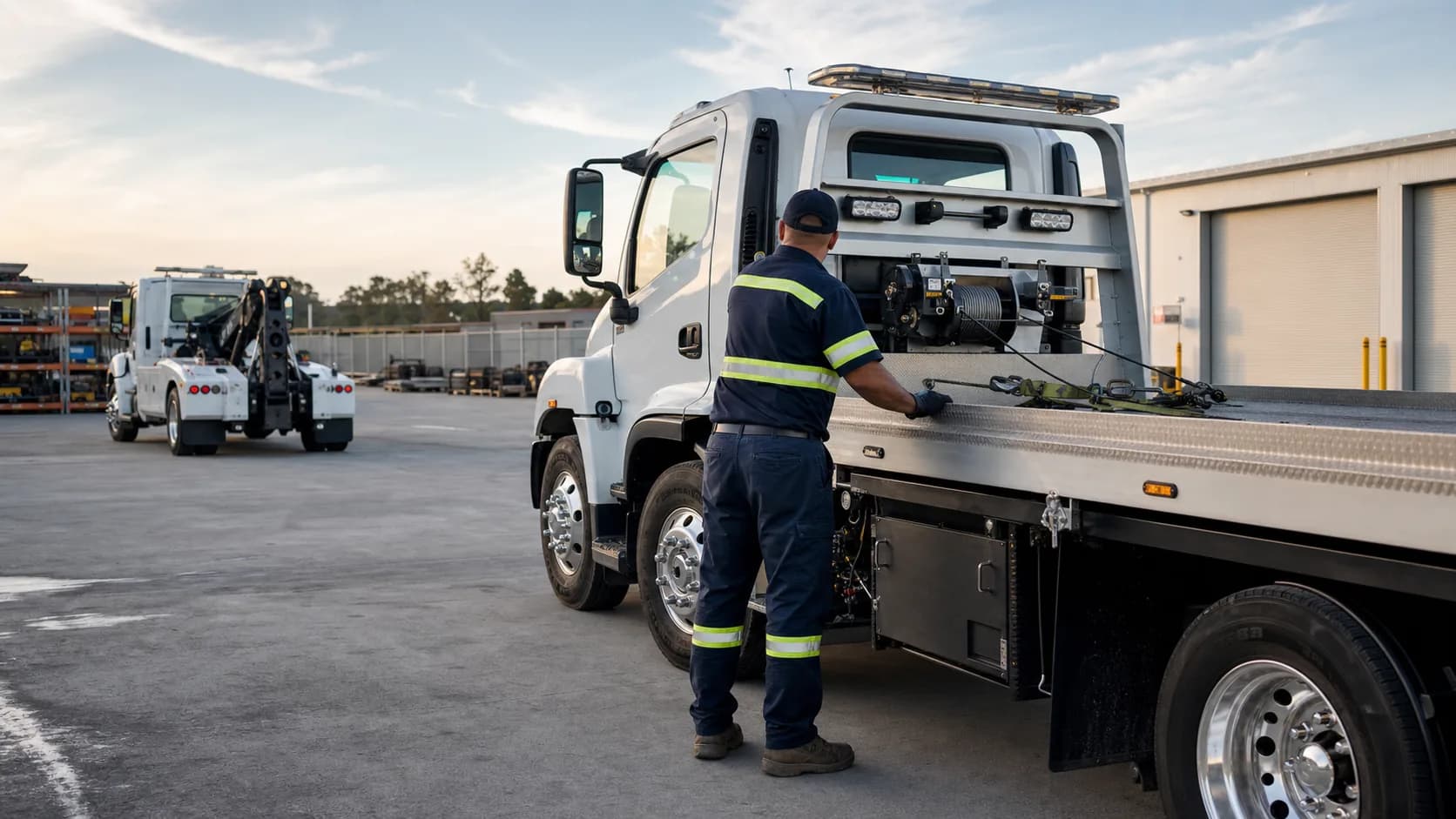
The truck type shapes the risk profile. Wheel-lift units are common for light-duty calls. They leave the towed vehicle's front or rear end on the ground, which means on-hook damage risk is built into the method. Carriers watch wheel-lift operations closely. Flatbeds and rollbacks are preferred because the vehicle rides fully on the deck — less contact, less damage risk.

Heavy wreckers handle semi-truck recovery and major accident scenes; that's a distinct risk class with higher on-hook limits and frequent law enforcement involvement. If you run a mixed fleet, carriers want a clear breakdown by service type. A submission that segments the fleet and the work moves more cleanly through underwriting.

Roadside, recovery, and repo are three different businesses from an underwriting standpoint. Roadside work (jump starts, lockouts, simple tows) is moderate-risk with cooperative customers. Recovery is different — off-the-embankment calls, overturned trucks, highway accident scenes at night — the on-hook exposure is higher and struck-by risk is real. Repossession stands apart.

Repo towing involves vehicles whose owners may not consent, which adds confrontation risk that doesn't exist in roadside or recovery. Some carriers won't write repo at all. Others require higher limits or apply exclusions. If you do repo work — even occasionally — disclose it upfront. An undisclosed work type can create a coverage problem exactly when you need coverage most.

Standard commercial auto doesn't cover the vehicle on your hook. When something happens to a towed vehicle — a strap failure, a drop during loading, a braking incident — that's an on-hook loss. Physical damage doesn't cover it. General liability doesn't cover it. On-hook towing coverage (also called Towing Legal Liability) fills that gap. Set the limit to the highest-value vehicle you're likely to have attached.

Luxury cars, high-value trucks, and commercial equipment all push that number up. Understating the limit leaves you short on the worst calls.

Your storage lot creates a different exposure than the road does. When you hold vehicles after a tow — impound holds, awaiting pickup, holding for a shop — you carry garagekeepers exposure. Two coverage forms exist. On a legal liability basis, you're covered only when you're legally responsible for the damage. Hail damages 12 cars in your lot? You're probably not at fault for weather — that claim may not be covered.

On a direct primary basis, damage is covered regardless of fault. Hail hits 12 cars — covered. Direct primary costs more, but it matches how tow operators actually face claims. Customers expect to be made whole for damage in your yard, whatever caused it. Most operators with active storage lots need direct primary.

Dispatch structure matters in underwriting. Multi-truck operations with dedicated dispatch add complexity. Carriers want to know how many trucks run at once, how drivers are assigned, and whether you use GPS or telematics. Documented dispatch and route management presents differently than a loosely coordinated fleet.

If you have GPS on your trucks, include it in the submission — carriers treat it as a positive risk signal.

MVRs carry real weight in towing placement. Tow drivers work long shifts under time pressure in difficult conditions. A driver with at-fault accidents, DUI history, or a pattern of violations creates a harder placement. Some carriers will decline that driver, restrict them to certain units, or decline the whole account. Honest MVR disclosure at submission gives carriers the complete picture.

A record that surfaces during a claim investigation is a far worse outcome than one that was disclosed upfront.

Know your actual radius before carriers ask. Local work within 50 miles reads differently than regional operations crossing state lines. Interstate scene response and long-haul recovery are distinct profiles from city or county roadside work. Radius is one of the first rating questions on a towing account — have the accurate answer, not an estimate.

Police rotation and motor-club contracts each set their own insurance floor. Rotation contracts come with specific requirements: mandated limits, garagekeepers coverage, storage lot specs, sometimes bonding. The contracting authority sets what you must carry — and those requirements often exceed a standard towing policy.

Motor-club contracts (AAA, Agero, Urgently, NSD, and others) carry their own on-hook minimums and auto liability requirements. Certificate holder lists for towing operators grow fast: motor clubs, municipalities, property managers for private-property impound, and auto dealers for commercial accounts. Track them before the stack catches you short.

Towing gets more underwriting attention than most commercial auto classes. Accident-scene operations, frequent handling of damaged property, roadside struck-by exposure, and historically higher on-hook claim frequency are why. Carriers that specialize in towing write it regularly — it's not uninsurable. But the submission has to do the work. Describe the operation clearly. Document the fleet by type.

Disclose every work category. Show MVRs. Include loss history. That's what produces usable options and fewer surprises when renewal comes.

Coverage

Coverages commonly considered for towing operations

These are common lines to evaluate, not a preset package. Your operations, current contracts, state requirements, and the carrier's policy forms determine the final program.

  • Commercial Auto Liability

    Towing vehicles operating on public roads must satisfy applicable financial-responsibility requirements. The policy's covered-auto symbols, drivers, work types, radius, liability limits, and physical-damage terms require review. Police-rotation and motor-club requirements depend on the current agreement.

  • On-Hook Towing Coverage (Towing Legal Liability)

    The moment a vehicle is attached, standard commercial auto stops covering it. On-hook coverage fills that gap, responding to damage during transport: a drop during loading, a chain failure, a braking incident, a third vehicle striking the towed car. Set the limit to the highest-value vehicle you're realistically likely to have attached. A low on-hook limit on an expensive tow is a direct out-of-pocket loss.

  • Garagekeepers Legal Liability

    Storage exposure is separate from road exposure. This coverage protects against damage claims on vehicles in your custody at an impound yard or storage lot. Two forms: legal liability (covers you only when you're legally at fault) and direct primary (covers damage regardless of fault — weather, vandalism, theft included). Operators with active lots typically need direct primary. The right form depends on lot volume, vehicle values, and how customers actually respond to damage claims.

  • Physical Damage (Comprehensive and Collision)

    Tow trucks are expensive, and a unit out of service is revenue stopped. Physical damage covers the fleet against collision, fire, theft, and weather events. Lienholders on financed or leased equipment require it as a condition of the financing. Even owned equipment warrants the conversation — replacing a heavy wrecker out of pocket is a significant hit to an operation of any size.

  • General Liability

    Some exposures don't flow through the vehicle. A customer who slips on your lot, a bystander hurt during a recovery, property damage at a scene where commercial auto doesn't respond — those are GL claims. Motor clubs and municipalities frequently require GL as a separate line from commercial auto. Private-property impound agreements often require it as well. A towing operation with an active lot has premises exposure alongside road exposure.

  • Workers' Compensation

    Roadside towing is physically hazardous work. Heavy lifting, operating recovery equipment, and working in live traffic lanes create genuine injury exposure. Workers' comp covers medical costs and a portion of lost wages when an employee is hurt on the job. Required in most states from the first hire — and towing operations face real claim frequency in this category.

  • Umbrella / Excess Liability

    Primary limits can erode quickly in a serious accident-scene event or a significant on-hook claim. An umbrella adds capacity above your commercial auto, general liability, and employers' liability. Police rotation contracts and municipal towing agreements often specify total limit requirements that only an umbrella can reach. Review the umbrella alongside your primary stack when pursuing contract work.

Quote factors

Common quote factors

These are the details that can shape eligibility, terms, and pricing. You don't need all of them to start — send what you have, and we'll follow up on anything important that's missing.

  • Type of towing performedRoadside assist, light recovery, heavy wrecker, repo, motor club, private property impound, police rotation — each carries a different risk profile. Some require specific coverage forms. Carriers need an accurate breakdown of your work mix.
  • Number of tow trucksFleet count drives the premium base and shapes dispatch risk assessment. Owner-operators with one unit are rated differently than operations running eight or ten trucks.
  • Vehicle year, make, model (if available)Equipment type matters as much as count. Wheel-lift, flatbed/rollback, or heavy wrecker — along with age and stated value — are all part of how carriers classify the physical damage risk.
  • Vehicle valuesThe basis for physical damage coverage. Understating value means a gap at total-loss time, when the actual shortfall becomes impossible to avoid.
  • Radius of operationLocal, regional, or multi-state recovery work affects classification and placement. Give carriers the actual radius, not the minimum that sounds better.
  • Driver count and driver history (MVRs)Every driver gets individual review. Towing accounts are among the most MVR-sensitive in commercial auto. Have records organized before the submission.
  • Storage lot exposureWhether you store vehicles, how many, and what security measures are in place determines whether garagekeepers coverage is needed and which form applies.
  • On-hook limits neededThe highest-value vehicle you're likely to tow drives this number. A limit set too low makes the policy gap visible only at the worst possible time.
  • Garagekeepers needed?Yes or no, and if yes, direct primary or legal liability basis. That form choice has real consequences on how claims respond.
  • Prior lossesAuto, on-hook, garagekeepers, and GL claims for typically 3 to 5 years. Disclosed loss history produces more realistic options than undisclosed history discovered later.
  • Current policy (optional upload)Reviewing your existing declarations page shows current limits, coverage gaps, and endorsements before the quoting process starts.
  • Needed-by dateEspecially important for operations adding a new truck, securing a new contract, or approaching a rotation renewal with a hard deadline.
Illustrative scenarios

Example claim scenarios

A few situations that show how coverage can respond when something goes wrong. These are examples only — not actual claims, and not a guarantee of any outcome.

  • Example scenario

    On-hook vehicle drop during loading

    A wheel-lift tow truck is loading a sedan for a city impound call. During the lift, a strap fails and the front of the vehicle contacts the pavement — hood, bumper, and both front quarter panels are damaged. The vehicle is in the operator's care, custody, and control at the time of the loss. On-hook coverage responds up to the policy's limit. Without it, this is an out-of-pocket loss.

    Commercial auto liability does not cover property in your care. Subject to the policy's terms and exclusions.

  • Example scenario

    Storage-lot hail and vandalism — garagekeepers claim

    A hailstorm damages 15 vehicles in a towing operator's impound lot overnight. The next morning, two also show vandalism — broken windows, scratched paint. On a direct primary garagekeepers policy, all 15 are covered up to the garagekeepers limit, regardless of fault. On a legal liability form, the hail damage may not be covered — weather isn't the operator's fault. Vandalism would be evaluated separately.

    This is why the direct vs. legal question matters for operators with active storage lots.

  • Example scenario

    Roadside struck-by incident

    A tow truck driver is hooking up a vehicle on a highway shoulder at night. A motorist drifts onto the shoulder and strikes the driver. The injuries are serious — emergency care, surgery, extended time off work. Workers' Compensation responds to cover medical costs and a portion of lost wages. General Liability and/or Commercial Auto may also be involved, depending on the specific facts.

    Roadside work is one of the highest-hazard environments in commercial auto. Workers' Comp is critical for any towing operation with employees.

  • Example scenario

    Liability at an accident-scene recovery

    A towing operator clears a disabled vehicle at a highway interchange. While maneuvering, equipment from the tow truck contacts an adjacent vehicle that law enforcement hadn't moved yet, causing additional damage. The owner files a claim against the towing company. Depending on the facts, this could be a General Liability or Commercial Auto Liability claim — or both.

    Having both coverages with adequate limits is important for operators who work accident scenes regularly.

The claim scenarios above are illustrative examples only. They do not represent actual clients, actual claims, or guaranteed coverage outcomes. Coverage for any specific situation depends on the policy terms, conditions, exclusions, and the facts of the claim.

After you bind

Common certificate and service needs

After a carrier binds coverage, contracts and operational changes can create new documentation needs. A certificate summarizes policy information; the policy and its endorsements control coverage.

Contract and certificate requests

  • Motor-club document requestsrequirements vary by company and current agreement. Send the insurance section and certificate instructions so BLIS can compare them with the policy and coordinate carrier-approved documentation where available.
  • Police rotation and municipal contractscity and county contracts specify required minimums: auto liability limits, garagekeepers coverage, sometimes a bond. Review the insurance specifications before pursuing or renewing a rotation. Gaps found after the contract is awarded are harder to address than gaps found before.
  • Property-management and private-property impound agreementsa current contract may request a certificate, additional-insured endorsement, or specific limits. The policy and carrier-issued endorsement—not the certificate—control additional-insured status.
  • Higher liability limits for contract workmunicipal towing contracts often set auto liability minimums at $1,000,000 or above. Some also require umbrella coverage. Contract terms vary — read the insurance section before signing.
  • Primary and non-contributory or waiver requestsreview the current agreement and ask the carrier for applicable endorsements. Availability and effect depend on the policy form and the covered claim.

Ongoing service

  • Mid-term fleet and driver changesadding or replacing a tow truck requires a policy endorsement. A new driver requires MVR review and potentially a driver endorsement before they operate under the policy. BLIS handles mid-term changes so coverage reflects the fleet and roster as they actually stand.
  • MVR review for new driverstowing accounts are MVR-sensitive. Some carriers require a pull at the time a new driver is added mid-term. Running a driver who isn't cleared on the policy creates an eligibility question at claim time.
  • On-hook and garagekeepers limit reviewsexpanding to a storage yard, taking on higher-value vehicles, or adding new contract work can change your on-hook or garagekeepers exposure significantly. Limit reviews belong alongside any material operational change.
  • Coverage updates for new contracts or rotation awardsnew towing agreements often require updated limits or new endorsements. BLIS reviews what the contract requires and coordinates the policy changes.
  • Renewal preparationtowing accounts with on-hook or auto claims benefit from getting to renewal early. Organize loss runs and an account summary 60 to 90 days out. More lead time means more market options.
  • Workers' comp audit supportWC policies audit actual payroll at year-end. BLIS can help you understand the audit process and gather the documentation carriers request.
  • Claim navigationBLIS can help you understand the claims process, organize documentation, and communicate with the carrier after an incident.

FAQ

Frequently asked questions

Coverage availability, pricing, terms, conditions, and eligibility depend on underwriting, carrier guidelines, state, operations, loss history, policy terms, and other risk-specific factors. Nothing on this site guarantees coverage, pricing, placement, or savings.

Examples are hypothetical and illustrative. They show how a coverage can respond, not a promise that any specific claim will be covered. Actual coverage depends on your policy's terms, conditions, and exclusions.

On-hook towing coverage and garagekeepers legal liability are distinct coverages with their own terms, limits, conditions, and exclusions. Consult the specific policy form for coverage details applicable to your operation.

Blue Lagoon Insurance Services, LLC is an independent insurance agency licensed in California (0M74955), Nevada (3983946), Arizona (3003332484), Texas (2966873), and Florida (L120266).