Transportation · Moving Companies

Moving Company Insurance for Other People's Belongings

Moving companies carry a risk profile that general freight trucking policies weren't designed for. Your cargo is people's furniture, electronics, and irreplaceable personal property, not commercial freight. Claims come from customers, not corporate shippers. Injuries happen during stair carries and furniture lifts, not just on the road. BLIS reviews the full account. That covers authority type, cargo valuation structure, fleet and crew size, storage exposure, and the auto and liability coverage your operation actually needs.

Licensed commercial insurance support across 5 states

Smart intake

Moving Companies quote

One question to start. We do the reading from there.

Start your quote

Get Started

Request a Trucking insurance quote

Complete the required contact fields and a few business details. A licensed BLIS representative will review the request.

1 / 2About you

How to reach you about your request.

We use this only to follow up.

Licensed in CA, NV, AZ, TX, and FL.

We only use this information to review your insurance request. BLIS is licensed in California, Nevada, Arizona, Texas, Florida. CA License 0M74955.

Submitting this form does not bind coverage and does not promise a specific quote, price, or coverage outcome. BLIS reviews submitted details and may follow up for information needed to evaluate the account.

What to expect

What to expect after you submit

A BLIS representative reviews the information you submit and follows up if something important is missing.

  1. A real person reads it

    Your details get read against what carriers actually want for your kind of account — not routed through a form stack.

  2. Your account gets matched

    How you operate maps to the coverage lines and markets that fit the risk.

  3. Gaps get filled

    If something important is missing, a few targeted questions — not another long form.

  4. Options get laid out

    Coverage, exclusions, carrier fit, and cost — side by side, not just price.

  5. Bound? We stay on.

    Certificates, endorsements, audits, renewals, policy changes — handled.

Prefer to talk it through? Call (818) 306-8333Monday – Friday, 9:00 AM – 5:00 PM PT

Your operation

How moving companies operations shape the insurance review

Furniture, antiques, and someone's grandmother's china. That is what your crew is accountable for — not pallets of commercial freight. When damage happens, the claimant is standing in the same room where the crew worked. That dynamic sets moving insurance apart. The coverage has to match: cargo valuation tied to what customers select, crew injury exposure from physical labor, the household goods regulatory layer, and any warehouse liability the operation carries.

Cargo valuation — where the policy and the move contract meet. Released value protection caps your liability at a low per-pound rate; the carrier charges nothing extra. Full value protection bases liability on replacement or repair cost; the carrier typically charges more. Both options define your legal liability to the customer — they are not insurance products in themselves.

Claims turn on which option the customer selected, whether disclosure happened correctly, and how the cargo policy responds to that specific liability ceiling. A per-item sublimit lower than the item's value is where the gap most often opens.

Pianos, artwork, and antiques — the items that break the weight formula. Standard cargo limits are often sized for average household goods, not for a Steinway or a signed original. Per-item sublimits cap recovery regardless of appraised value. A customer who paid six figures for a piece expects that value back, not what a weight-based calculation permits.

Reviewing what your operation actually moves — and whether the cargo structure accounts for it — matters before a crew leaves the dock.

Stair carries, heavy appliances, uneven surfaces — the injury happens before anything rolls. Back injuries, knee injuries, and shoulder strains run through the household goods industry's Workers' Compensation claim history for a straightforward reason: the work is physically punishing. Class codes for movers and drivers carry their own rate profiles.

Payroll by job category affects premium and the audit outcome at year-end. Crew size swings seasonally, so an estimate at inception often looks different from audited payroll by December.

Moving claims are not freight claims — the claimant was watching. A business shipper files a cargo claim through a logistics department. A consumer files one because your crew touched everything they own. Frequency of small customer damage claims tells underwriters something about how the operation handles property. Pattern matters as much as severity.

One bad claim on a clean record reads differently than ten modest ones spread across three years.

Storage liability is a separate exposure line, not a footnote to the cargo policy. Property staged in your warehouse during a gap between sales is in your care, custody, and control — and your transit cargo policy may not extend to it. Fire, water intrusion, pest damage, and theft in storage have produced claims that caught operators without the right coverage.

Warehouseman's legal liability addresses the mover's liability for stored goods. It is not the same instrument as the building's property policy.

Cargo vans, 16-foot trucks, and 26-footers — each rated on its own risk profile. Commercial auto does not treat a sprinter and a large box truck the same way. Physical damage coverage needs to reflect true replacement value, not book value on a truck that's been refurbished since manufacture. Drivers who rotate across vehicle sizes raise classification questions underwriters will ask before terms are set.

Cross a state line and the regulatory picture changes entirely. Local movers answer to state rules. Interstate household goods carriers are regulated by the FMCSA under 49 CFR Part 375 and need active HHG operating authority. The distinction drives three things: which financial responsibility filings apply, what customer disclosures are required, and how cargo liability is structured.

Growing from local to interstate means addressing both the regulatory filing and the insurance structure before the first out-of-state job.

Summer is when the moves happen. Audit season is when the math catches up. Workers' Compensation premium is calculated on actual payroll, not the estimate used at inception. Crew size during peak months can run well above the annual average, and carriers reconcile that gap at expiration. An accurate payroll estimate — including the seasonal swing — reduces the audit bill that arrives after the busy season ends.

FMCSA authority for household goods comes with its own filing requirements. Interstate movers need an active MC number, the HHG designation, and proof of insurance on file with the FMCSA — typically a BMC-91 or Form E endorsement. That filing confirms minimum financial responsibility to the regulator. It is separate from the policy itself.

Adding interstate authority or transitioning from intrastate operations means coordinating the regulatory filing alongside the insurance placement — one does not automatically satisfy the other.

Coverage

Coverages commonly considered for moving companies operations

These are common lines to evaluate, not a preset package. Your operations, current contracts, state requirements, and the carrier's policy forms determine the final program.

  • Commercial Auto Liability

    Cargo vans, 16-foot trucks, 26-footers — all need commercial auto. These are not personal vehicles running errands. Large trucks navigating residential streets carry real bodily injury and property damage exposure on every job. The policy lists each vehicle and each driver by motor vehicle record. For interstate movers, a BMC-91 or Form E endorsement attaches to the policy and satisfies the FMCSA's financial responsibility requirement. That filing and the policy itself are two separate documents serving different purposes.

  • Motor Truck Cargo (Household Goods)

    This is not general freight cargo. The household goods valuation framework shapes how a claim resolves. Which option the customer selected, what per-item sublimits apply, and what commodity exclusions exist — all three determine the outcome. Electronics, jewelry, fine art, and antiques often face per-item caps below actual replacement cost. Reviewing those limits against the goods your crews move is part of building a cargo structure that holds when a claim arrives.

  • Warehouseman's Legal Liability

    Cargo forms may limit or end transit coverage once property enters storage. A moving company offering storage services takes on care, custody, and control of customer belongings for weeks or months. Review the cargo and warehouse forms together, including covered causes, valuation, exclusions, and the maximum value in storage.

  • General Liability

    Scratching a hardwood floor, clipping a door frame, a customer stepping over a furniture dolly and going down. None of those scenarios involve a vehicle in motion, so commercial auto does not respond. GL does. Premises liability exposure from a warehouse or dispatch office also falls here. Commercial property managers frequently require moving companies to name them as additional insureds on a GL policy before permitting access.

  • Workers' Compensation

    Movers lift appliances, carry furniture on stairs, and work in physically demanding positions all day. Back injuries, shoulder injuries, and knee injuries are the recurring claim types. WC is required for employees in most states from the first hire. Payroll classification — drivers, loaders, warehouse staff, office employees — affects both the premium rate and what the audit examines at year-end. Seasonal crews make accurate payroll estimation a meaningful planning item.

  • Physical Damage (Comprehensive and Collision)

    Moving trucks take punishment. Tight residential streets, loading ramps, and dock situations chip away at the fleet. An agreed value structure preserves replacement cost for working vehicles. Actual cash value may come up short on trucks that have depreciated. Financed or leased trucks require this coverage as a lender or lessor condition. How a total loss translates into a settlement depends on which structure the policy uses.

  • Umbrella / Excess Liability

    A serious accident with a fully loaded 26-foot truck in a residential neighborhood can reach or surpass standard auto liability limits. Multiple injured parties and significant property damage can arrive in the same claim. An umbrella responds after those primary limits are exhausted. Some commercial property managers require umbrella or excess coverage as a condition of allowing a move in their building.

Quote factors

Common quote factors

These are the details that can shape eligibility, terms, and pricing. You don't need all of them to start — send what you have, and we'll follow up on anything important that's missing.

  • Number and type of vehicles (cargo vans, box trucks, semi-trailers)Fleet composition drives commercial auto rating. Carriers want to understand the full range of vehicle sizes and how each is used. A 26-foot box truck and a cargo van carry different risk profiles.
  • Vehicle year, make, model, VIN, and stated valueEquipment age and value drive physical damage rating and lender requirements. Older moving trucks with refurbishments may carry book values that don't reflect replacement cost. Accurate stated values matter.
  • Driver count and MVR historyEach driver's motor vehicle record is individually reviewed. Movers who operate large trucks in residential neighborhoods are evaluated closely. A driver history with recent violations or license actions affects carrier eligibility and pricing.
  • Radius of operations (local, intrastate, or interstate)The operation may handle only local moves, intrastate moves, or interstate household goods moves. That changes the regulatory filing structure. It also affects the carrier market options and how the account is underwritten.
  • FMCSA or state PUC authority statusInterstate household goods carriers require an active MC number and FMCSA HHG authority. The insurance policy must carry the appropriate financial responsibility endorsement (BMC-91 or Form E). Carriers want to know how long the authority has been active.
  • Cargo valuation option offered to customersThe operation may offer released value protection only, or it may also offer full value protection. That affects how cargo liability is structured and priced. Operations that assume full liability for replacement value carry a different underwriting profile.
  • Types of goods moved (general household goods vs. high-value specialty items)Some moving companies routinely handle high-value items such as pianos, antiques, fine art, and electronics. They carry a different cargo underwriting profile. The cargo policy's per-item limits should align with the goods being moved.
  • Storage services offered and estimated storage volumeMoving companies providing warehouse or mobile storage services need to disclose one figure. That is the total value of goods in storage at any one time. This affects the warehouseman's legal liability limit and the overall coverage structure.
  • Annual payroll (total and by employee category)Payroll is the primary Workers' Compensation rating basis. Carriers want payroll broken out by job category (drivers/movers, warehouse staff, office/dispatch) because each classification carries its own rate. Seasonal payroll swings should be estimated accurately.
  • Crew size (peak and off-peak)Moving operations are seasonal. Crew size variation between peak and off-peak months affects payroll estimates and audit exposure. Accurate peak and off-peak estimates help reduce end-of-year audit adjustments.
  • Prior loss history (last 3–5 years)Loss runs for cargo claims, auto liability, and Workers' Compensation are all reviewed. Frequency of customer damage claims and severity of any auto or WC incidents shapes how carriers evaluate the account.
  • Current policy (upload optional)Reviewing existing declarations and endorsements helps identify coverage gaps and limit adequacy. It also shows whether the current structure addresses storage exposure, valuation options, and FMCSA filings correctly.
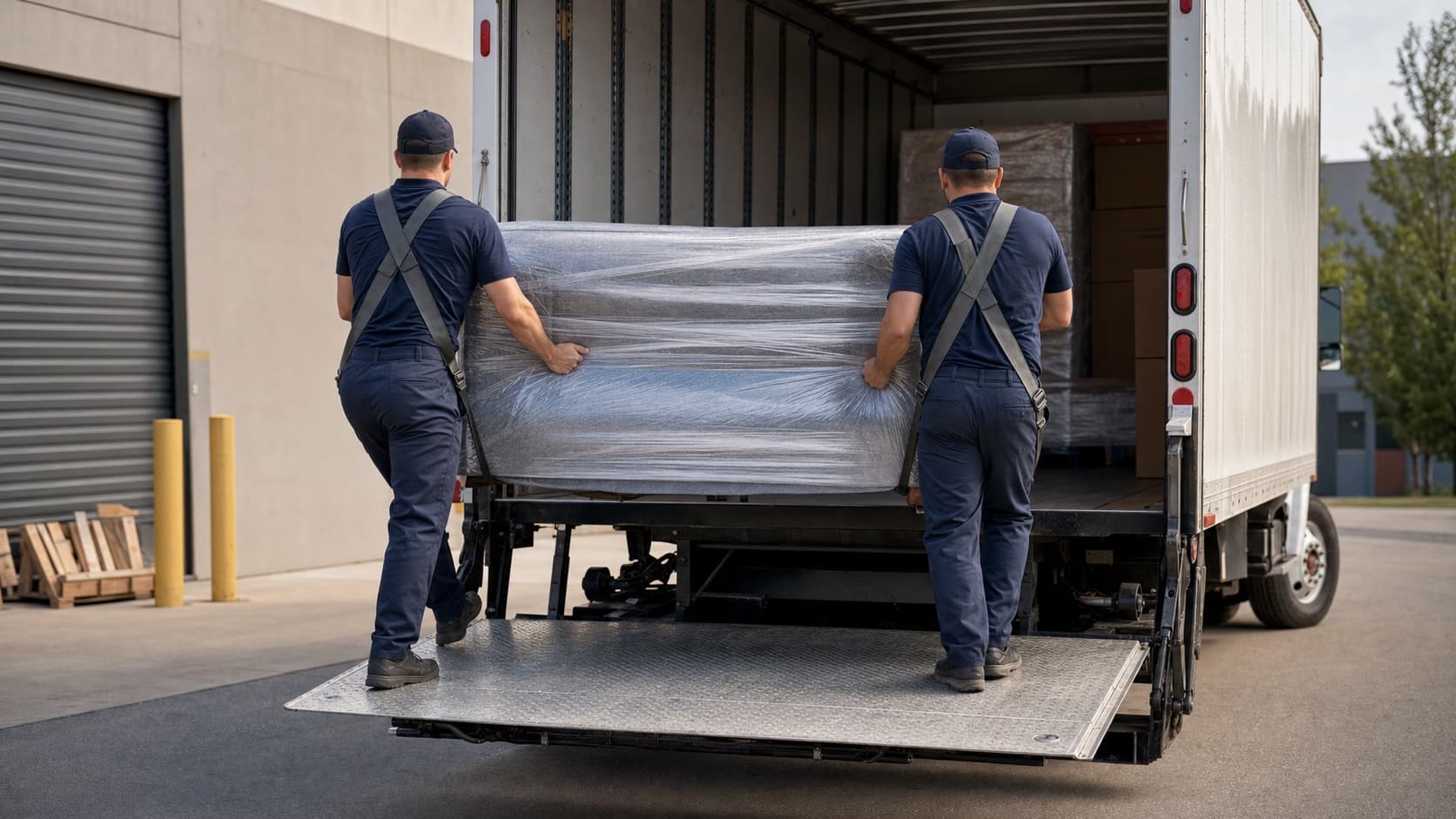
Illustrative scenarios

Example claim scenarios

A few situations that show how coverage can respond when something goes wrong. These are examples only — not actual claims, and not a guarantee of any outcome.

  • Example scenario

    Damaged high-value item during a residential move

    A moving crew transports a family's belongings to a new residence. During unloading, a large antique armoire contacts a door frame and sustains a visible crack. The customer selected released value protection at booking. That limits the mover's liability to a per-pound rate well below the antique's appraised value. The customer disputes the settlement and files a complaint with the state moving authority.

    Motor truck cargo coverage can respond to the carrier's legal liability under the applicable valuation terms. Any response is subject to the policy's per-occurrence limits, per-item sublimits, and the valuation option documented at pickup.

  • Example scenario

    Mover injury during a stair carry

    A two-person crew carries a large sofa down a flight of stairs in an apartment building. One crew member loses footing, falls, and sustains a knee injury requiring medical treatment and recovery time. Workers' Compensation can respond to medical expenses and a portion of lost wages, subject to the policy's terms and the applicable state statute.

    The physical demands of moving make musculoskeletal injuries a recurring exposure in the household goods industry. Those demands are stair carries, heavy lifts, and uneven surfaces throughout the day.

  • Example scenario

    Storage unit damage claim during a multi-month hold

    A customer stores household belongings in a moving company's warehouse during a gap between home sales. During a three-month storage period, a minor roof leak causes water damage to furniture and personal items. The customer submits a claim. Whether the moving company's general cargo policy responds to damage during storage, as opposed to during transit, depends on the specific policy terms.

    Warehouseman's legal liability coverage is designed to address the mover's legal liability for property damaged while in storage. That is a separate exposure from the transit cargo line.

  • Example scenario

    Property damage to a building during a commercial office move

    A moving company conducts a commercial office move, transporting furniture, IT equipment, and office contents from one building to another. While navigating a large desk through a corridor, the crew scratches and dents freshly painted hallway walls. The building management company submits a claim for repair costs. Commercial auto liability may not respond because the incident did not involve a vehicle in motion.

    It occurred during carrying operations inside the building. General liability can respond to third-party property damage from the moving operation itself, subject to the policy's terms and exclusions. Building managers often require movers to name them as additional insureds on a GL policy before permitting the move.

The claim scenarios above are illustrative examples only. They do not represent actual clients, actual claims, or guaranteed coverage outcomes. Coverage for any specific situation depends on the policy terms, conditions, exclusions, and the facts of the claim.

After you bind

Common certificate and service needs

After a carrier binds coverage, contracts and operational changes can create new documentation needs. A certificate summarizes policy information; the policy and its endorsements control coverage.

Contract and certificate requests

  • Certificate of insurance for residential building accessapartment complexes, condominium associations, and high-rise buildings require proof of coverage before your trucks and crew arrive. Some specify minimum GL limits. Many require the building management company named as an additional insured. Know what the building needs before the move is scheduled.
  • Certificate of insurance for commercial property accessoffice buildings and business parks want commercial auto liability and general liability confirmed before a move is permitted. Minimum limit requirements and additional insured endorsements are standard. A certificate that shows the right numbers must be backed by the corresponding endorsements in the actual policy.
  • FMCSA financial responsibility filings (BMC-91 or Form E)interstate household goods movers must carry the appropriate FMCSA endorsement on the commercial auto policy. It confirms minimum financial responsibility to the regulator. Issued as part of the policy, it is a distinct document from the declarations page.
  • Loss payee certificates for vehicle financing or lease agreementslenders and equipment lessors on financed or leased trucks need to appear as loss payees on physical damage coverage. Certificates confirming that listing are typically required at closing.
  • Additional insured certificates for storage facility leaseslandlords of warehouse space typically require a certificate naming them as an additional insured on general liability. Standard condition of most commercial lease agreements.

Ongoing service

  • Mid-term vehicle additionseach new truck belongs on the commercial auto policy before it runs its first job. An unscheduled vehicle creates a gap that only becomes visible at claim time. We process the endorsement and confirm the updated certificate goes to any lender or lessee who needs it.
  • Driver additions and MVR coordinationnew crew members who will operate vehicles need to be on the driver roster before keys change hands. Some carriers review a new driver's MVR before extending coverage. BLIS works through that step as part of the mid-term addition.
  • Seasonal payroll review before peak seasonadjusting the Workers' Compensation estimate ahead of summer reduces the audit gap in January. A payroll figure set in the slow season may not reflect what the busy months actually produce.
  • Workers' Compensation audit supportWC audits at expiration compare actual payroll by classification against the inception estimate. We walk through the records carriers look for so a seasonally variable payroll does not produce a surprise bill at year-end.
  • FMCSA authority expansionadding interstate authority or a second MC number requires coordinating the regulatory filing alongside the insurance placement. Neither process completes the other automatically. BLIS works through what the policy needs to carry as that process moves forward.
  • Renewal strategycargo, auto, and Workers' Compensation loss runs all feed the renewal evaluation. Enter renewal with current loss runs, accurate payroll data, and a clear account of operational changes. That picture helps the account be reviewed on its actual merits.
  • Claims support and documentationafter an incident, BLIS helps you understand what the carrier needs, how the reporting process works, and what questions are likely to come up. That applies to customer damage claims, vehicle accidents, and crew injuries.

FAQ

Frequently asked questions

Coverage availability, pricing, terms, conditions, and eligibility depend on underwriting, carrier guidelines, state, operations, loss history, policy terms, and other risk-specific factors. Nothing on this site guarantees coverage, pricing, placement, or savings.

Examples are hypothetical and illustrative. They show how a coverage can respond, not a promise that any specific claim will be covered. Actual coverage depends on your policy’s terms, conditions, and exclusions.

Blue Lagoon Insurance Services, LLC is an independent insurance agency licensed in California (0M74955), Nevada (3983946), Arizona (3003332484), Texas (2966873), and Florida (L120266). BLIS does not underwrite insurance; coverage and underwriting decisions are made by the insurance carrier.

References to FMCSA requirements, household goods authority, BMC-91 filings, state PUC authority, and other regulatory matters are general informational context only. Regulatory requirements vary by operation type, state, authority type, and the specific nature of the moves conducted. Confirm your specific compliance obligations with a qualified transportation attorney or the relevant regulatory agency. BLIS is an insurance agency, not a regulatory compliance service.