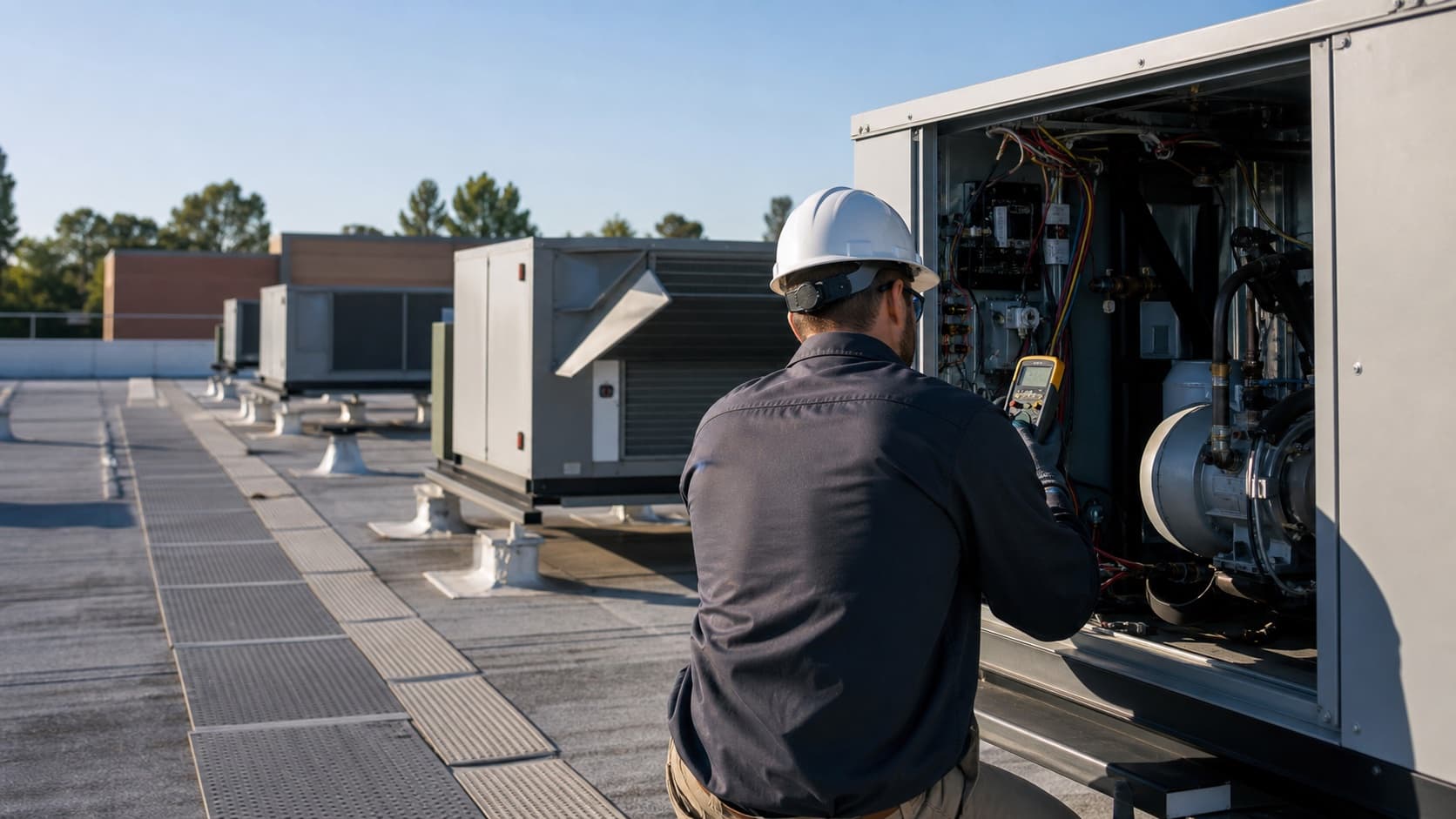
Construction · HVAC Contractors

HVAC Contractor Insurance for Gas, Refrigerant, and Live Electrical

HVAC contractors work across combustion systems, refrigerant lines, electrical connections, and ductwork. Your insurance needs to reflect that range. New construction, commercial retrofits, and residential service calls can all be part of one account. Payroll spans multiple trade class codes. Tools and refrigerant equipment ride in the field. Completed operations exposure outlasts any single job. GCs and property managers require specific endorsements. BLIS reviews the whole account before placing coverage.

Licensed commercial insurance support across 5 states

Smart intake

HVAC quote

One question to start. We do the reading from there.

Start your quote

Get Started

Request a Contractor & Trade insurance quote

Complete the required contact fields and a few business details. A licensed BLIS representative will review the request.

1 / 2About you

How to reach you about your request.

We use this only to follow up.

Licensed in CA, NV, AZ, TX, and FL.

We only use this information to review your insurance request. BLIS is licensed in California, Nevada, Arizona, Texas, Florida. CA License 0M74955.

Submitting this form does not bind coverage and does not promise a specific quote, price, or coverage outcome. BLIS reviews submitted details and may follow up for information needed to evaluate the account.

What to expect

What to expect after you submit

A BLIS representative reviews the information you submit and follows up if something important is missing.

  1. A real person reads it

    Your details get read against what carriers actually want for your kind of account — not routed through a form stack.

  2. Your account gets matched

    How you operate maps to the coverage lines and markets that fit the risk.

  3. Gaps get filled

    If something important is missing, a few targeted questions — not another long form.

  4. Options get laid out

    Coverage, exclusions, carrier fit, and cost — side by side, not just price.

  5. Bound? We stay on.

    Certificates, endorsements, audits, renewals, policy changes — handled.

Prefer to talk it through? Call (818) 306-8333Monday – Friday, 9:00 AM – 5:00 PM PT

Your operation

How hvac operations shape the insurance review

Most trades work one hazard at a time. HVAC contractors work all of them simultaneously — combustion systems, refrigerant lines, live electrical, and ductwork in a single shift. Payroll spans install and service classifications. Tools and recovery equipment ride in the field daily. A completed ops tail follows every system you commission. GCs and property managers come with specific endorsement demands. Every one of those pieces shapes the account. BLIS reads all of them before placing coverage.

Refrigerant and combustion exposure. HVAC technicians handle EPA Section 608 refrigerants, high-voltage electrical, and gas-fired combustion equipment in the same shift. A refrigerant leak in a tenant space is a third-party GL claim. A cracked heat exchanger can send carbon monoxide into occupied living space. Severity can reach bodily injury territory — not just property damage.

That combustion profile is distinct from most other construction trades.

Completed ops tail — equipment failure after the technician leaves. When a system fails months after commissioning, the completed ops portion of GL is what responds. New construction HVAC carries that tail past project closeout for as long as the building operates. Check the aggregate limit and any exclusions for specific refrigerants or system types.

The stakes are highest on larger commercial installations where a failed system affects an entire building.

Payroll split across multiple WC class codes. New installation is coded differently from residential service and repair. Sheet metal duct work carries its own classification. Misallocating payroll between codes — even without intent — creates audit exposure. Audit adjustments run in both directions, but the surprises usually land at year-end.

BLIS reviews the payroll and work-type breakdown to identify correct codes before the policy is written.

Tools and refrigerant recovery equipment in the field. A loaded service truck carries gauge sets, recovery machines, vacuum pumps, combustion analyzers, and sheet metal tools. That equipment is at risk when a vehicle is broken into at a multi-family property or commercial site. Commercial property tied to the business address does not reach equipment in a vehicle or at a remote location.

An inland marine floater covers the tools and equipment wherever the work takes them.

Certificate demands from GCs and property managers. HVAC subcontractors on commercial projects field requests with detailed endorsement language: additional insured, primary and non-contributory, waiver of subrogation. Required limits often run above standard policy limits. Property managers run vendor compliance checks on their own cycle.

What matters is that the endorsements are actually in the policy — the certificate is a summary document, not a grant of coverage.

Residential vs. commercial work split. Service-focused residential accounts are underwritten differently than commercial install or large tenant improvement projects. The split shapes GL class codes and which insurers may consider the account. Some carriers restrict commercial install above a certain project size. Report the revenue split — residential vs. commercial, new install vs.

service/repair — accurately at application and renewal. A material mid-term shift without disclosure creates a gap.

New construction vs. service and maintenance. Rough-in and commissioning during new construction creates equipment that runs in the building for decades. Service agreements — filter changes, tune-ups, reactive repairs — are a different model: higher volume, smaller scope, more frequent. Both models create commercial auto exposure. Service vans, driver profiles, and operating radius all affect pricing.

Every technician is behind the wheel regularly.

Subcontractor certificate hygiene. HVAC contractors using specialty subs — sheet metal shops, duct fabrication crews, electrical subcontractors — inherit exposure when those subs are uninsured. GL policies often carry conditions tied to subcontractor insurance status. Collect and retain certificates before subs mobilize. An uninsured sub's claim can land on your policy.

Coverage

Coverages commonly considered for hvac operations

These are common lines to evaluate, not a preset package. Your operations, current contracts, state requirements, and the carrier's policy forms determine the final program.

  • Workers' Compensation

    Rooftops, mechanical rooms, attics, live electrical, gas systems. HVAC technicians work across environments that carry real fall, burn, and injury exposure. WC covers medical expenses and lost wages as required by state law. Payroll can span multiple codes — installation, service/repair, sheet metal, administrative. The audit outcome depends on how that payroll is allocated at the start. BLIS reviews work type and payroll mix to identify the right class codes before the policy is written.

  • General Liability

    GL covers third-party bodily injury, property damage, and completed ops claims. Completed ops carries particular weight for HVAC work. A refrigerant leak, a CO event, or a failed system can generate a claim months or years after the technician left the site. GL also responds to jobsite property damage caused during the work. Review limits, exclusions, and endorsement requirements against what the contract actually demands.

  • Commercial Auto

    Each technician drives a loaded vehicle to every call. Commercial auto can cover liability for accidents and physical damage to the vehicles. A personal auto policy excludes business use of employer-owned vehicles — a real and common gap. Fleet size, driver history, and vehicle type each affect how carriers price this line.

  • Inland Marine

    Tools, Equipment & Refrigerant Recovery — Refrigerant recovery units, gauge sets, vacuum pumps, and combustion analyzers travel in service vehicles and stage overnight at commercial sites. An inland marine floater follows that equipment wherever the work takes it — something commercial property tied to the business address cannot do. Coverage can be scheduled by item or written on a blanket basis. Setting the limit below actual values creates a gap when a loss occurs.

  • Umbrella / Excess Liability

    The umbrella layers above your GL and commercial auto, paying once those limits run out. For HVAC contractors doing commercial work inside occupied buildings, a combustion event or refrigerant-related claim can reach or exceed standard GL limits. Some GC subcontracts and property management agreements specify minimum umbrella limits. When the contract demands it, the umbrella moves from option to requirement.

  • Commercial Property (where applicable)

    HVAC contractors with a duct shop, parts warehouse, or office have fixed assets that inland marine does not cover. Equipment at the business address, fabrication tools, and parts inventory all carry value. Commercial property protects them. If refrigerant cylinders or recovered product are stored on-site, review what the property policy excludes before assuming coverage exists.

Quote factors

Common quote factors

These are the details that can shape eligibility, terms, and pricing. You don't need all of them to start — send what you have, and we'll follow up on anything important that's missing.

  • Type of HVAC work performedCarriers separate residential service/repair, light commercial, commercial install, industrial, and refrigeration-specific work. Each carries a different risk profile and maps to its own GL class code.
  • Residential vs. commercial revenue split (%)The split drives GL class code selection and determines which insurers may consider the account. A service/repair-heavy book is underwritten differently from a commercial new-install operation.
  • New install vs. service and repair split (%)Preventive maintenance, reactive repair, and service agreement revenue create a different exposure picture than system commissioning. Carriers look at the business model, not just the revenue total.
  • Annual payroll and class code breakdownPayroll is the WC rating base. How payroll is divided across installation, service/repair, sheet metal fabrication, and administrative roles determines the rate applied to each dollar. Accuracy at inception reduces audit surprises.
  • Number and type of service vehiclesVehicle count, weight class, and driver profile feed commercial auto pricing. Driver history and prior loss experience are reviewed alongside the fleet.
  • Tools and refrigerant equipment valueTotal replacement value for specialty tools and recovery units sets the inland marine limit. Understating value at binding creates a gap the floater cannot close at loss.
  • Subcontractor usage and value paidCarriers want to know whether subs carry their own GL and WC. Sub receipts may also factor into GL rating, depending on the policy form.
  • Prior loss history (last 3–5 years)Frequency and severity both affect how carriers price and underwrite the account. Completed ops or combustion-related claim history draws particularly close review.
  • Service agreement or maintenance contract revenueOngoing service revenue signals a different exposure pattern than project-based installation. Carriers may ask specifically about the share tied to service agreements.
  • Current policy (upload optional)Existing declarations pages surface limit adequacy issues, coverage gaps, and endorsement problems before the submission goes out.
  • Certificate requirements from GCs or property managersKnowing the endorsements and limits your contracts require confirms the policy is structured correctly before the first certificate is issued.

Illustrative scenarios

Example claim scenarios

A few situations that show how coverage can respond when something goes wrong. These are examples only — not actual claims, and not a guarantee of any outcome.

  • Example scenario

    Completed operations — refrigerant leak in a commercial tenant space

    An HVAC contractor installs a split-system unit in a commercial office as part of a tenant improvement project. Months after closeout, the system develops a refrigerant leak that goes undetected. The tenant reports damage to sensitive equipment. The building owner pursues a claim against the HVAC contractor, alleging a defective refrigerant connection.

    The claim runs through the completed ops portion of the GL policy. Key questions: is the completed ops aggregate adequate? Does the carrier exclude refrigerant-related losses? Do policy limits match the property values at risk? Coverage responds subject to the policy's terms and exclusions.

  • Example scenario

    Workers' Compensation — rooftop injury during a service call

    An HVAC technician loses footing on a wet rooftop during a maintenance call and sustains an injury requiring medical treatment. Workers' Comp responds to medical expenses and lost wages as required by state law. HVAC technicians working at height and in mechanical rooms with live electrical carry regular fall and injury exposure.

    It is central to the WC underwriting picture for this trade — subject to the policy's terms and conditions.

  • Example scenario

    Refrigerant recovery equipment theft from service vehicle

    An HVAC technician parks a company van at a multi-family property during a service call. On returning, the van has been broken into — a recovery machine, manifold gauge set, and vacuum pump are gone. The stolen equipment affects the technician's ability to complete scheduled calls. A commercial property policy tied to the business address does not cover equipment stolen from a vehicle at a remote location.

    Inland marine — a tools and equipment floater — is the line designed for this type of loss, subject to the policy's terms and exclusions.

  • Example scenario

    Carbon monoxide event tied to combustion system servicing

    An HVAC contractor performs a furnace service call at a residential property, including heat exchanger inspection and burner adjustment. Afterward, occupants report carbon monoxide symptoms and a CO alarm activates. An investigation attributes the event to a cracked heat exchanger letting combustion gases into the living space.

    The homeowner files a bodily injury and property damage claim, alleging the crack should have been found during the call. GL responds to third-party bodily injury and property damage claims from the work. A combustion-related event at a residential property can reach significant medical and legal costs, subject to the policy's terms and exclusions.

The claim scenarios above are illustrative examples only. They do not represent actual clients, actual claims, or guaranteed coverage outcomes. Coverage for any specific situation depends on the policy terms, conditions, exclusions, and the facts of the claim.

After you bind

Common certificate and service needs

After a carrier binds coverage, contracts and operational changes can create new documentation needs. A certificate summarizes policy information; the policy and its endorsements control coverage.

Contract and certificate requests

  • Certificate of insurance (COI) requestsyou typically need a COI before mobilizing on each project and again when a GC or property manager runs a compliance check. Send any specific endorsement demands so BLIS can confirm the policy supports what the certificate needs to reflect.
  • Additional insured endorsementsGC subcontracts and property management agreements often require your GL to name the GC, property owner, or management company as additional insureds. Endorsements can be blanket or scheduled. The policy language — not the certificate face — determines what that status actually provides in a claim.
  • Waiver of subrogationGC contracts routinely require you to waive the insurer's right to pursue the GC for recovery after a covered claim. That waiver has to be in the policy endorsement to hold up when a claim is made.
  • Primary and non-contributory wordingcommercial project contracts often require your GL to respond first, before any coverage the additional insured carries. The policy language needs to match what the contract demands.
  • Completed ops coverage confirmation for project owners on commercial HVAC install work. A system commissioned today runs in that building for years. Some contracts specify minimum completed ops aggregate limits.
  • Certificates for service agreement or maintenance contract onboardingproperty managers and building owners often require current certificates from HVAC service vendors before approving a vendor relationship.

Ongoing service

  • Mid-term policy changesa new van, a technician added to the roster, or higher limits required by a property manager all need a policy change or endorsement. BLIS handles those changes and issues updated documentation.
  • Workers' Compensation payroll audit preparationWC policies audit at expiration. The carrier compares actual payroll and class code breakdown to the estimate used at binding. BLIS reviews what records carriers commonly request — especially for accounts with payroll across installation, service/repair, and sheet metal.
  • Class-code review at year-endconfirming that payroll allocation across HVAC installation, service/repair, sheet metal, and administrative roles reflects what the crews actually did. Catching a mismatch before the audit cycle matters.
  • Renewal strategycarriers re-evaluate HVAC accounts at renewal based on updated payroll, revenue mix, loss history, and operational changes. BLIS reviews what has shifted and presents the submission so underwriters see the account clearly.
  • Coverage comparison when renewing or re-marketing the accountevaluating options across coverage terms, exclusions, limits, and endorsements.
  • Claims questions and carrier coordinationcombustion events, refrigerant losses, and completed ops property damage claims can involve more than one coverage line. BLIS helps you understand the process and work through the communication with the adjuster.

FAQ

Frequently asked questions

Coverage availability, pricing, terms, conditions, and eligibility depend on underwriting, carrier guidelines, state, operations, loss history, policy terms, and other risk-specific factors. Nothing on this site guarantees coverage, pricing, placement, or savings.

Examples are hypothetical and illustrative. They show how a coverage can respond, not a promise that any specific claim will be covered. Actual coverage depends on your policy's terms, conditions, and exclusions.

Blue Lagoon Insurance Services, LLC is an independent insurance agency licensed in California (0M74955), Nevada (3983946), Arizona (3003332484), Texas (2966873), and Florida (L120266). BLIS does not underwrite insurance; coverage and underwriting decisions are made by the insurance carrier.