Construction · Painting Contractors

Painting Contractor Insurance for Spray Crews and Split Payroll

Your risk profile is shaped by the surfaces, chemicals, and GC certificate demands of each jobsite. BLIS reviews the full account: payroll across multiple WC class codes, vehicle use, subcontractor certificates, and the completed operations exposure that follows a job after the crew moves on.

Licensed commercial insurance support across 5 states

Smart intake

Painting quote

One question to start. We do the reading from there.

Start your quote

Get Started

Request a Contractor & Trade insurance quote

Complete the required contact fields and a few business details. A licensed BLIS representative will review the request.

1 / 2About you

How to reach you about your request.

We use this only to follow up.

Licensed in CA, NV, AZ, TX, and FL.

We only use this information to review your insurance request. BLIS is licensed in California, Nevada, Arizona, Texas, Florida. CA License 0M74955.

Submitting this form does not bind coverage and does not promise a specific quote, price, or coverage outcome. BLIS reviews submitted details and may follow up for information needed to evaluate the account.

What to expect

What to expect after you submit

A BLIS representative reviews the information you submit and follows up if something important is missing.

  1. A real person reads it

    Your details get read against what carriers actually want for your kind of account — not routed through a form stack.

  2. Your account gets matched

    How you operate maps to the coverage lines and markets that fit the risk.

  3. Gaps get filled

    If something important is missing, a few targeted questions — not another long form.

  4. Options get laid out

    Coverage, exclusions, carrier fit, and cost — side by side, not just price.

  5. Bound? We stay on.

    Certificates, endorsements, audits, renewals, policy changes — handled.

Prefer to talk it through? Call (818) 306-8333Monday – Friday, 9:00 AM – 5:00 PM PT

Your operation

How painting operations shape the insurance review

Paint, solvents, and payroll across three class codes — that is the risk picture in one line. High headcount relative to revenue, spray-equipment exposure, and a near-universal GC certificate requirement shape every account in this trade. Carriers read it closely. A generic contractor package misses the WC code split, the pollution question on solvent work, and the endorsement language your GC subcontracts actually demand. Getting those right at application matters more than finding the cheapest premium.

WC class codes and the payroll split. Three classifications, three rate tiers — interior, exterior, and spray applicators each carry distinct codes in most state rating bureaus. Exterior work at height rates differently than interior finish painting. Contractors with crews in more than one category need the payroll allocated correctly at application.

A mismatch between what is reported and what the audit finds means additional premium owed for the full policy year. Describe the mix before the policy is issued, not after the audit letter arrives.

Spray equipment, solvents, and overspray risk. Airless spray rigs, pressure washers, thinners, and acid wash create a property damage and pollution exposure some standard GL policies handle poorly. Overspray landing on an unintended surface is one of the more frequent claims in this trade. Chemical contact with finished surfaces runs deeper.

Solvent-based primers and strippers applied incorrectly can damage floors, fixtures, and architectural finishes. Carriers ask what coatings are used and how overspray is controlled on active jobsites.

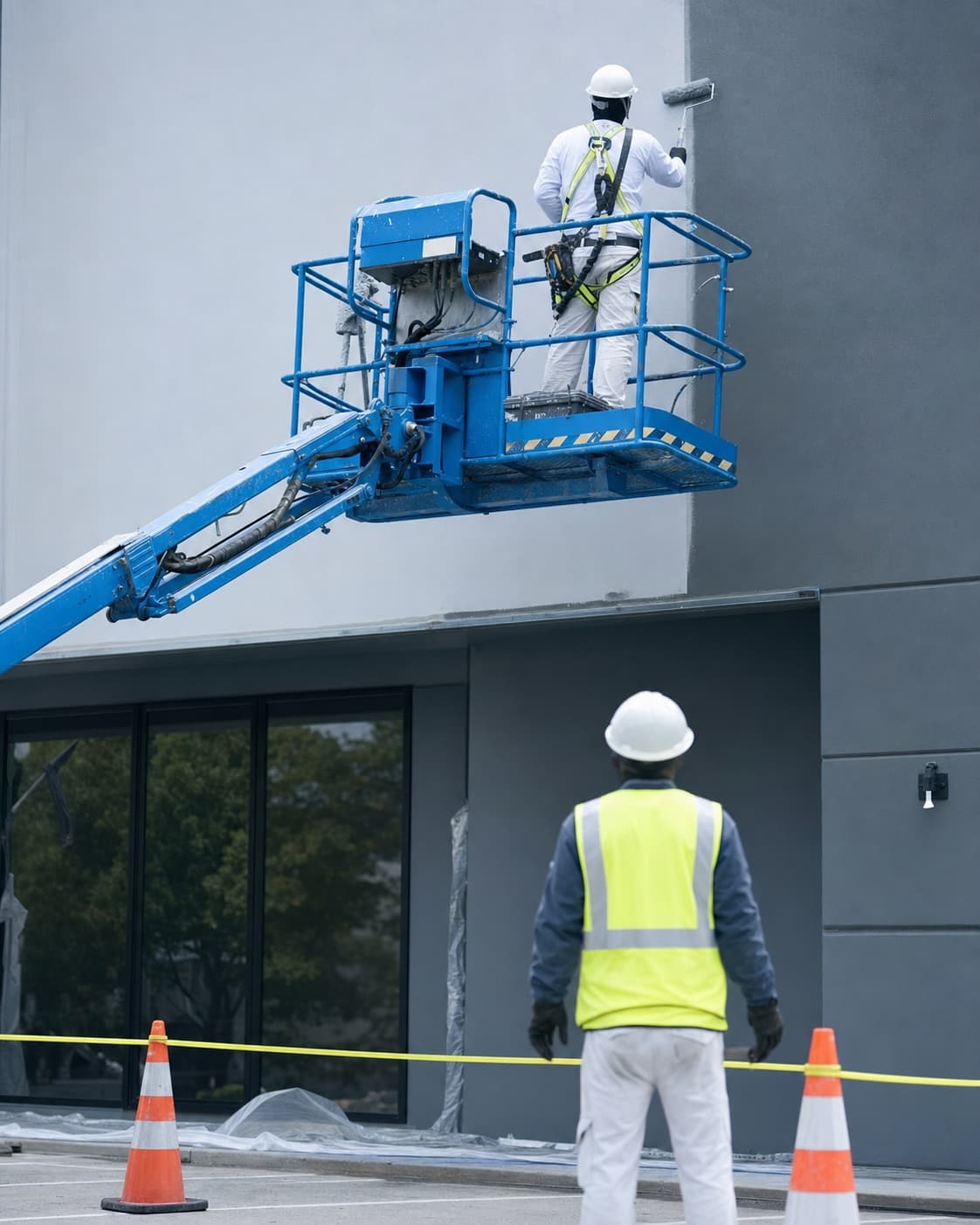
Work at height and scaffold exposure. Ladders, scaffolding, and aerial lifts are routine for exterior crews on multi-story buildings and apartment complexes. Fall injuries rank among the most costly WC claims across the trades. Painting crews log more time elevated than most other finish trades. Scaffold tie-offs, lift inspection, and equipment staging are all underwriting questions.

Contractors who regularly work on multi-story exteriors should expect WC rates to reflect the frequency of that exposure.

Residential versus commercial project mix. Carriers draw a hard line between residential interior, residential exterior, and commercial painting — for both GL class-code purposes and which markets are willing to write the account. Commercial tenant improvement and large exterior repaints involve bigger contracts, more demanding certificate requirements, and more expensive substrate damage if a coating fails.

Residential work brings its own lead-paint and occupied-home exposures. Report the work-type split accurately at application — misrepresenting it creates coverage and audit risk.

Lead-based paint in older structures. Structures built before 1978 may contain lead-based paint. Surface prep — sanding, scraping, or pressure washing — disturbs it and creates both legal and insurance exposure. Federal and state rules require RRP certification for this work. A standard GL pollution exclusion may leave a gap for lead-exposure allegations. Carriers ask about pre-1978 work at application.

Know what your GL says about pollution-related claims before the scenario arises, not after.

GC subcontract and certificate demands. Nearly every GC requires a certificate before a painting sub mobilizes. Additional insured endorsements, waiver of subrogation, primary-and-non-contributory language, and varying minimum limits show up across project contracts. Managing certificates across multiple active GC relationships is a recurring task.

Endorsements must be in the actual policy — not just referenced on the certificate face. A missing endorsement is only discovered when a claim is contested, not when the certificate is issued.

Completed operations and coating failures. Peeling, bubbling, or substrate damage from a coating failure can generate a claim months or years after the project is closed out. A workmanship warranty dispute stays in contract territory. But property damage to the underlying substrate — stucco, framing, or finishes — can become a third-party GL event under the completed operations aggregate.

Contractors doing large exterior repaints on commercial or multi-family properties carry more exposure here than those doing smaller residential jobs.

Subcontractors and uninsured labor. Seasonal scale-up with 1099 crews raises a coverage question carriers address directly. If a sub is injured on your job and carries no Workers' Comp, state law may treat you as the employer for WC purposes. From a GL standpoint, a damage claim tied to a sub's work can implicate your policy if the sub's own GL doesn't cover it.

Collect active WC and GL certificates from every sub before work begins.

Coverage

Coverages commonly considered for painting operations

These are common lines to evaluate, not a preset package. Your operations, current contracts, state requirements, and the carrier's policy forms determine the final program.

  • Workers' Compensation

    Exterior painting crews work at height every day. Fall frequency drives WC pricing in this trade. WC is mandatory for employees across all of BLIS's licensed states. Payroll spans multiple class codes: interior painters, exterior painters, and spray applicators are rated separately. Accurate classification at application reduces the audit adjustment at year-end. BLIS reviews the payroll split and work-type mix at intake to place codes before the policy is issued.

  • General Liability

    GL is what every GC requires before a painting sub steps on the jobsite. For this trade, exclusions matter as much as limits. Overspray, chemical contact, and surface damage claims sit near the boundary of the standard pollution exclusion. Completed operations is equally relevant: coating failures can generate a third-party property damage claim after the job is signed off. Additional insured, waiver of subrogation, and primary/non-contributory endorsements must be in the actual policy, not just referenced on the certificate.

  • Commercial Auto

    Vans and trucks carrying spray rigs, ladders, and paint supplies are working assets in this trade. A personal auto policy excludes business use. When a vehicle loaded with equipment is involved in an accident, the claim touches both commercial auto and inland marine. BLIS reviews the vehicle roster, employee driver exposure, and occasional use of rented lifts or flatbeds at application.

  • Inland Marine

    Spray Equipment & Tools — Airless spray rigs, pressure washers, compressors, scaffolding frames, and specialty tools travel from job to job. A commercial property policy anchored to a fixed address doesn't follow them. Inland marine covers scheduled spray equipment, general tool coverage, and scaffolding in transit or staged at active sites. Overnight theft from a job van is a recurring exposure in this trade.

  • Umbrella / Excess Liability

    A single overspray event on a high-value commercial property, or a serious fall claim, can reach standard GL per-occurrence limits. Umbrella coverage sits above the GL and commercial auto and responds once those are exhausted. Painting contractors on large commercial exteriors or new construction where GC contracts set minimum umbrella limits need to confirm underlying limits match what the contract requires.

  • Pollution Liability (where applicable)

    The pollution exclusion in a standard GL policy can affect coverage for lead paint disturbance, solvent-related damage, or chemical contact claims. Contractors doing renovation work in pre-1978 structures, or using acid wash and solvent-based coatings, face a gap the standard GL may not fill. A pollution endorsement or separate policy addresses it. Confirm what the GL actually covers — not what you assume — before a chemical-related claim makes the question urgent.

Quote factors

Common quote factors

These are the details that can shape eligibility, terms, and pricing. You don't need all of them to start — send what you have, and we'll follow up on anything important that's missing.

  • Type of painting work performedCarriers separate residential interior, residential exterior, commercial interior, commercial exterior, and specialty coatings such as epoxy floors and industrial coatings. Each carries a different risk profile and may map to different class codes or markets.
  • Residential vs. commercial work mix (%)The split shapes GL class codes and carrier appetite. Commercial GC relationships add certificate demands and endorsement complexity. An accurate percentage at application matters for rating accuracy and for finding the right market.
  • Work in pre-1978 structures (lead paint)Carriers ask whether the account touches older residential or commercial stock where lead paint may be disturbed during prep. RRP certification status also factors in. The answers affect both GL underwriting and how the pollution exclusion analysis runs.
  • Annual payroll by classificationPayroll is the WC rating basis. The division between interior painters, exterior painters, spray applicators, and administrative staff drives the classification structure and the final rate. Accurate splits reduce audit risk at year-end.
  • Employee count and subcontractor usageHeadcount drives WC exposure. Sub usage raises a GL question about uninsured labor. Carriers expect to know whether subs carry their own WC and GL. Seasonal or casual labor arrangements need to be described clearly at application.
  • Spray equipment types and valuesAirless rigs, HVLP sprayers, and pressure washers each carry different overspray and replacement-cost profiles. Equipment values set the inland marine limit; the types of equipment used shape how carriers assess the property damage risk.
  • Number and type of vehiclesWork vans, trucks, and trailers drive commercial auto structure and pricing. Vehicle count, use type, and whether employees regularly operate company vehicles are all underwriting inputs.
  • Prior loss history (last 3–5 years)Overspray claims, WC injuries, and vehicle accidents are the most common loss patterns in this trade. Frequency and severity both affect how carriers evaluate the account. Undisclosed losses create audit and coverage risk at renewal.
  • Current policy (upload optional)Declarations pages help identify coverage gaps, limit adequacy, and whether the endorsements GC contracts require are already in the policy.
  • Certificate requirements from GCsKnowing the endorsements and minimum limits required before mobilization allows BLIS to structure the submission so the certificate is ready when the job starts.
  • Needed-by dateMobilization dates or GC contract start requirements set a realistic timeline for the submission and quote process.

Illustrative scenarios

Example claim scenarios

A few situations that show how coverage can respond when something goes wrong. These are examples only — not actual claims, and not a guarantee of any outcome.

  • Example scenario

    Overspray damage to adjacent property

    A painting crew applies exterior coating to a two-story commercial building on a day with intermittent wind. Despite drop cloth protection at ground level, paint mist drifts and settles on several vehicles in an adjacent lot. The vehicle owners file a property damage claim. GL can respond to third-party property damage claims of this type, subject to the policy's terms and exclusions.

    Overspray claims are among the more frequent GL events in the painting trade. Severity depends on the coating type, the affected surface, and how quickly the damage is found.

  • Example scenario

    Employee fall from scaffolding

    A painter on a two-story exterior residential repaint job steps off a scaffolding plank and sustains a lower-extremity injury requiring surgery and several weeks of lost work. Workers' Comp can respond to medical expenses and lost-wage benefits as required by state law, subject to the policy's terms and conditions. Fall injuries from elevated work surfaces are among the more severe WC claims in the trades.

    Painting contractors with exterior crews working above the first floor carry meaningful frequency exposure in this category.

  • Example scenario

    Lead paint disturbance and tenant exposure allegation

    A painting contractor is hired to repaint interior surfaces in a residential rental unit built in the 1960s. During surface preparation, sanding generates dust that tenants in the adjacent unit later allege caused exposure symptoms. The property owner and tenants file a complaint, and the contractor receives a demand letter.

    Whether a standard GL policy responds depends on the policy's pollution exclusion and whether any lead-related endorsements are in place. Contractors working in pre-1978 residential stock should understand what their GL says about pollution-related claims — before this scenario arises, not after.

  • Example scenario

    Coating failure and surface damage on a commercial project

    A painting contractor completes an exterior repaint on a multi-unit apartment complex using a specified elastomeric coating. Within several months, sections of the coating peel and bubble. Moisture infiltration behind the failed coating damages the underlying stucco and framing. The property owner makes a claim for remediation and recoating.

    GL completed operations coverage can respond to third-party property damage claims from completed work, subject to the policy's terms and exclusions. The line between a workmanship claim (generally a contract dispute) and a third-party property damage claim (potentially a GL event) depends on the specific facts and policy language.

The claim scenarios above are illustrative examples only. They do not represent actual clients, actual claims, or guaranteed coverage outcomes. Coverage for any specific situation depends on the policy terms, conditions, exclusions, and the facts of the claim.

After you bind

Common certificate and service needs

After a carrier binds coverage, contracts and operational changes can create new documentation needs. A certificate summarizes policy information; the policy and its endorsements control coverage.

Contract and certificate requests

  • Certificate of insurance (COI) requestssend the certificate holder name, address, and any required endorsement wording. BLIS confirms whether the policy supports what the certificate needs to show before it is issued.
  • Additional insured endorsementsGC contracts on commercial and multi-family projects routinely require the painting sub to name the GC and sometimes the property owner. Endorsements can be blanket or scheduled. The endorsement form must be in the actual policy — not just shown on the certificate face.
  • Waiver of subrogationa standard demand in GC subcontracts for this trade. Like the additional insured endorsement, the waiver must be in the policy language to hold when a claim arises.
  • Primary and non-contributory languagecommercial projects and larger property management accounts often require the painting sub's GL to respond before any GC coverage applies. A specific endorsement in the policy supports that wording.
  • Completed operations verificationproject owners and multi-family managers sometimes request written confirmation that the GL policy includes completed operations coverage.
  • Pollution liability endorsement documentation where a project contract calls out chemical or environmental exposure requirements.

Ongoing service

  • Policy changes and mid-term endorsementsnew work van, additional crew, higher GC-required limits: each needs a policy change and updated documentation. BLIS handles mid-term adjustments and issues revised certificates when needed.
  • WC audit supportpainting contractor WC policies audit at expiration against actual payroll and class code splits. Multiple class codes and seasonal crew variation are the two most common sources of audit surprises. BLIS reviews what carriers request and walks through what the classification examination will cover.
  • Payroll and class-code review at mid-term or year-endcatching misallocated payroll before the audit letter is more efficient than disputing the adjustment after.
  • Renewal strategyat renewal, carriers look at crew size changes, project mix shifts, and whether lead-paint or specialty coating work has been added. BLIS reviews what changed and structures the renewal submission to reflect the current account.
  • Subcontractor certificate collectionverifying that 1099 painters and subcontract crews carry active WC and GL before they start, and advising on what to collect and retain.
  • Market comparison at renewalevaluating coverage options means reviewing policy terms, endorsement availability, carrier appetite, and cost side by side.
  • Claims guidance after an overspray event, WC injury, or property damage incidentdocumentation, adjuster interaction, and timeline guidance.

FAQ

Frequently asked questions

Coverage availability, pricing, terms, conditions, and eligibility depend on underwriting, carrier guidelines, state, operations, loss history, policy terms, and other risk-specific factors. Nothing on this site guarantees coverage, pricing, placement, or savings.

Examples are hypothetical and illustrative. They show how a coverage can respond, not a promise that any specific claim will be covered. Actual coverage depends on your policy's terms, conditions, and exclusions.

Blue Lagoon Insurance Services, LLC is an independent insurance agency licensed in California (0M74955), Nevada (3983946), Arizona (3003332484), Texas (2966873), and Florida (L120266). BLIS does not underwrite insurance; coverage and underwriting decisions are made by the insurance carrier.